
- Tune up to the tuning shown in the video title, and add a capo if one is listed.
- Watch once without playing to hear the song and spot the hard parts.
- Learn one short section at a time, pausing and rewinding as often as you need.
- Slow the video down to 0.75× or 0.5× speed, then build back up to full speed.
- Play the whole song along with the video, then record yourself and listen back.
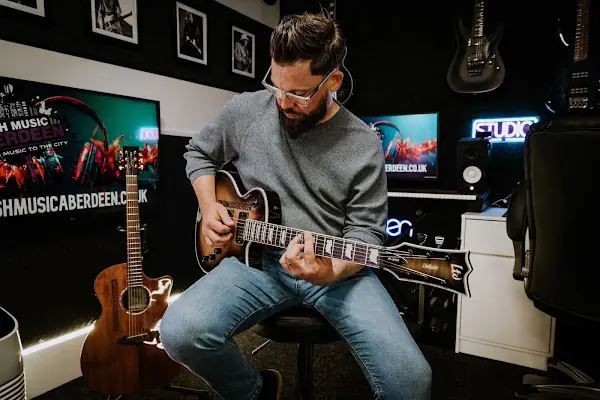
Free play-along TAB videos are one of the best ways to practise guitar, bass or drums between lessons. You hear the real song, see the tablature move in time and play along at your own pace. But just pressing play and hoping for the best rarely works. This guide from Connor Montgomery at Fresh Music Aberdeen explains how to read TAB, gives you a simple five-step method for practising with play-along videos and introduces the eight newest videos on the Fresh Music YouTube channel.
Quick answer
How to practise with a play-along TAB video
What is a play-along TAB video?
A play-along TAB video plays the original recording of a song while the music scrolls across the screen in time. Fresh Music videos show both standard notation and tablature, so you can follow whichever you prefer, and every video is filmed in 4K so the numbers are sharp even on a phone.
The TAB is either sourced from Ultimate Guitar (or Ultimate Drums for drum videos) or transcribed by Connor. Because the videos are written for individual Fresh Music students and tailored to their level, some parts are simplified or adapted. That makes them ideal for practice: you get a version of the song you can actually play, not just the hardest possible transcription.
New videos are added regularly, covering guitar, bass and drums across chart pop, indie, classic rock, country and more.
How to read TAB for guitar, bass and drums
Tablature (TAB) is a simple way of writing music that shows where to play rather than which note name to play. You can learn the basics in a few minutes.
- Guitar TAB has six lines, one for each string. The bottom line is the thickest string (low E) and the top line is the thinnest (high E). A number tells you which fret to press; 0 means play the string open. Numbers stacked on top of each other are played together as a chord.
- Bass TAB works the same way but has four lines, for the E, A, D and G strings, from bottom to top.
- Drum TAB gives each part of the kit its own line, such as crash, hi-hat, snare, toms and bass drum. An x or o marks when to hit, and the counts above show where each hit falls in the bar.
TAB on its own does not always show rhythm clearly, which is why the scrolling notation and the original recording are so useful: you can see the fret and hear exactly when to play it. If you want to understand the rhythm side properly, our article on playing by ear or reading music explains how the two skills work together.
A 5-step method for practising with play-along videos
This simple routine works for complete beginners and experienced players alike.
Step 1: Tune up and check the title
The video title tells you how to set up. “Standard Tuning” means normal E A D G B E tuning. “Capo 2” or “Capo 3” means put a capo on that fret, and the TAB numbers are then counted from the capo. “Eb Tuning” means tuning every string down a semitone. Getting this right first means the video will sound in tune with you.
Step 2: Watch and listen once without playing
Play the whole video through with your instrument on your lap. Listen to how the song is put together (intro, verse, chorus, bridge) and notice the bits that look tricky. This takes three or four minutes and saves a lot of frustration later.
Step 3: Learn one short section at a time
Pick a section of four to eight bars, often the main riff or the chorus. Pause the video, work out the shapes or the drum pattern, then rewind and try again. On a computer, the J and L keys jump back and forward ten seconds and the K key pauses, which makes looping a section quick.
Step 4: Slow it down, then speed it up
Open the settings (gear) menu on the YouTube player, choose Playback speed and pick 0.75 or 0.5. The pitch stays the same, so you can still play along in tune. Once you can play the section cleanly three times in a row, move the speed up a step. Playing slowly and accurately builds speed far faster than playing fast and messily.
Step 5: Play the whole song, then record yourself
When each section feels comfortable, join them together and play along with the full track at normal speed. Then record yourself on your phone and listen back. You will hear timing slips and buzzing notes you cannot notice while you are playing. Fresh Music students can also record in the studio during lesson time.
How to choose the right video for your level
The labels in each video title help you pick a version that suits you:
| Label in the title | What it means | Best for |
|---|---|---|
| Easy Play / Easier Play | A simplified arrangement of the song | Beginners and anyone learning a new style |
| Rhythm | The chords and strumming or picking pattern | Building timing and chord changes |
| Lead / Lead Part | Riffs, melodies and solos | Players working on single-note technique |
| Capo 2, Capo 3 | Play with a capo on that fret | Matching the original key with easier shapes |
| Standard Tuning / Eb Tuning | The tuning to use before you start | Everyone: check this first |
A good rule: choose a song you love that feels slightly too hard. If you can play it perfectly on the first try, it is too easy to teach you much. If you cannot manage a single bar after twenty minutes, pick an Easy Play or Rhythm version and come back to the full part later.
The latest Fresh Music play-along videos
Here are the eight newest play-along videos on the Fresh Music Aberdeen YouTube channel, uploaded in November 2026. There is something for guitar, bass and drums.

Kings of Leon — Pyro
Like on YouTube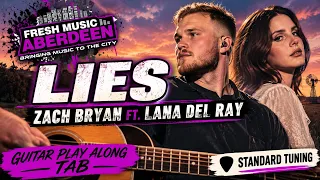
Zach Bryan ft. Lana Del Rey — Lies
Like on YouTube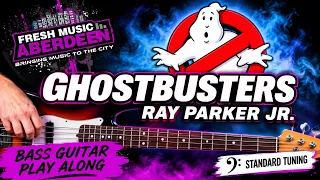
Ray Parker Jr. — Ghostbusters
Like on YouTube
Deaf Havana — Anemophobia (Easy Play)
Like on YouTube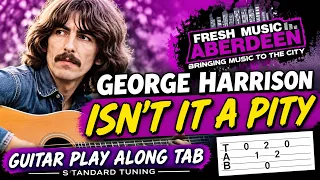
George Harrison — Isn't It A Pity
Like on YouTube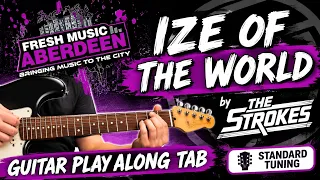
The Strokes — Ize of the World (Lead Part)
Like on YouTube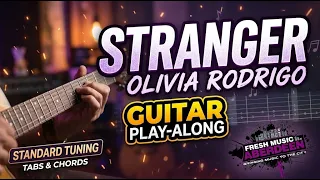
Olivia Rodrigo — Stranger
Like on YouTube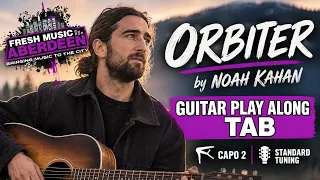
Noah Kahan — Orbiter (Capo 2 - Rhythm)
Like on YouTube| Song | Instrument | Version | Published |
|---|---|---|---|
| Kings of Leon — Pyro | Drums | Full drum part | |
| Zach Bryan ft. Lana Del Rey — Lies | Guitar | Standard tuning | |
| Ray Parker Jr. — Ghostbusters | Bass | Standard tuning | |
| Deaf Havana — Anemophobia (Easy Play) | Guitar | Standard tuning, easier arrangement | |
| George Harrison — Isn't It A Pity | Guitar | Full guitar part | |
| The Strokes — Ize of the World (Lead Part) | Guitar | Lead guitar part | |
| Olivia Rodrigo — Stranger | Guitar | Full guitar part | |
| Noah Kahan — Orbiter (Capo 2 - Rhythm) | Guitar | Capo on the 2nd fret, rhythm part |
Where to start:
- New to guitar? Try Anemophobia (Easy Play) by Deaf Havana or the rhythm part of Orbiter by Noah Kahan.
- Want to work on riffs? The lead part of Ize of the World by The Strokes is a great single-note workout.
- Learning bass? Ghostbusters by Ray Parker Jr. is a fun, groove-based bass line to lock in with.
- Learning drums? Play along with Pyro by Kings of Leon to work on a steady rock groove.
If you enjoy a video, please subscribe to the channel and give it a like on YouTube. It helps more musicians find the videos, and you will be the first to see new uploads.
Common mistakes to avoid
- Skipping the tuning check. If the video uses a capo or Eb tuning and you do not, nothing will sound right.
- Always starting from the beginning. Practise the hardest section first, while you are fresh.
- Playing at full speed too soon. Slow, clean repetitions are what build speed.
- Only watching. Watching a video is not practice. Keep your instrument in your hands and play.
- Never listening back. A quick phone recording shows you what to fix next.
When to add one-to-one lessons
Play-along videos are a brilliant practice tool, but a video cannot see your hands. It cannot tell you that your wrist is tense, that you are rushing the chorus or that there is an easier fingering for that riff. That is why the Fresh Music videos are designed to sit alongside lessons, not replace them, as we explain in why you should ditch YouTube.
At Fresh Music Aberdeen, the videos are written for individual students to practise between their weekly one-to-one lessons, tailored to each player's level and favourite music. Lessons are available for:
- Guitar lessons in Aberdeen (acoustic and electric)
- Bass guitar lessons in Aberdeen
- Drum lessons in Aberdeen
- Ukulele lessons in Aberdeen
Lessons take place at 11 Aspen Place, Stoneywood, Aberdeen AB21 9BA, Monday to Thursday from 9am to 9pm, and cost £20 for 30 minutes or £30 for 45 minutes, paid monthly by Direct Debit (see payment information). To book, fill in the enquiry form, email connor@freshmusicaberdeen.co.uk or call 07780 637 178.
Play-along TAB videos: quick answers
What is a play-along TAB video?
A play-along TAB video plays the original song while the tablature (and, on Fresh Music videos, standard notation) scrolls along in time, so you can see exactly which string and fret, or which drum, to play at each moment and play along with the real recording.
How do I read guitar TAB?
Guitar TAB has six horizontal lines, one for each string. The bottom line is the thickest (low E) string and the top line is the thinnest (high E) string. A number on a line tells you which fret to press on that string; 0 means play the string open. Read from left to right.
How do I read drum TAB?
Drum TAB gives each part of the kit its own line, such as hi-hat, snare and bass drum. An x or o on a line shows when to hit that drum or cymbal, and the counts above the lines show where each hit falls in the bar.
How can I slow down a YouTube play-along video?
Open the settings (gear) menu on the YouTube player, choose Playback speed and pick 0.75 or 0.5. On a computer you can also use the keyboard: Shift and the full stop key speeds the video up, Shift and the comma key slows it down. The pitch stays the same, so you can still play along in tune.
How long should I practise with play-along videos each day?
Short, regular sessions work best. Fifteen to thirty minutes on most days, focused on one or two short sections at a time, builds skill faster than one long session a week.
Are the Fresh Music play-along videos free?
Yes. Every play-along video on the Fresh Music Aberdeen YouTube channel is free to watch. The videos are made for individual students and tailored to their level, so some arrangements are simplified.
Can play-along videos replace music lessons?
They are a great practice tool, but a video cannot see you play, spot bad habits or adapt to your level. They work best alongside one-to-one lessons, which is exactly how Fresh Music Aberdeen students use them.
Where can I get guitar, bass or drum lessons in Aberdeen?
Fresh Music Aberdeen offers one-to-one guitar, bass guitar, drum and ukulele lessons at 11 Aspen Place, Stoneywood, Aberdeen AB21 9BA, Monday to Thursday from 9am to 9pm. Lessons cost £20 for 30 minutes or £30 for 45 minutes, paid monthly by Direct Debit.